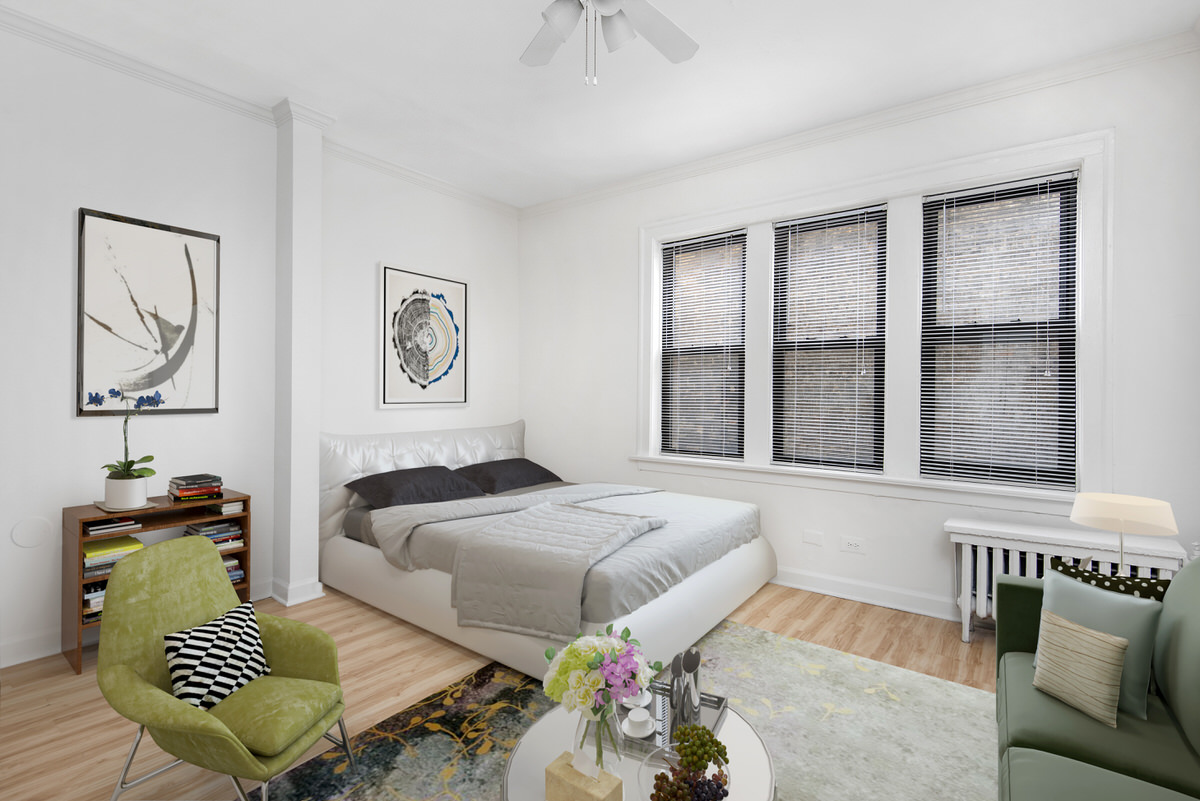
The studio-versus-one-bedroom question comes up for almost every graduate student apartment search, and it rarely gets answered well. Most of the advice online treats it as a pure budget calculation. If you can afford the one-bedroom, get it. If you can’t, make the studio work.
That framing misses most of what actually matters. The right answer depends on how you work, how you sleep, and what your program actually demands from your living space.
The Case for a Studio Apartment Is Stronger Than It Used to Be
Older studios in Chicago’s near north side neighborhoods tend to be larger than the category name suggests. A vintage studio in Lincoln Park or Lakeview East isn’t the same as a 400-square-foot new construction box. Many of them have genuine separation between the sleeping area and the main living space, good natural light, and enough room for a real desk setup.
For a graduate student who does most of their deep work in a library, a lab, or a campus building, the apartment is primarily a place to sleep, eat, and decompress. In that context, a well-laid-out studio covers everything that matters. You’re not shortchanging yourself — you’re matching the space to how you actually use it.
The financial difference is also real. In Lincoln Park or Gold Coast, the gap between a studio and a one-bedroom can run several hundred dollars or more per month. Over a two-year master’s program, that’s a meaningful number. For students carrying existing debt or funding their own degree, the studio’s cost advantage is a legitimate factor, not just a consolation.
Where a One-Bedroom Apartment Earns Its Cost
The one-bedroom justifies the premium when your apartment is genuinely your primary workspace. That’s true for a lot of graduate programs — dissertation writing, independent research, remote coursework, and programs without a strong on-campus culture all push students toward working at home more than they expect.
The practical value of a one-bedroom in those cases isn’t the extra square footage. It’s the door. Being able to close off the bedroom and use the living space as a dedicated study area — or close yourself into the bedroom when you need focus — creates a kind of compartmentalization that’s hard to replicate in a studio.
Sleep quality is also worth considering. Graduate school schedules are irregular, and the ability to keep your sleeping environment dark, quiet, and visually separate from wherever you work tends to matter more as the academic year gets harder. A studio requires discipline to maintain that separation. A one-bedroom builds it into the floor plan.
Program Type Is a Better Guide Than Budget Alone
A few questions cut through the studio-versus-one-bedroom debate faster than any cost comparison.
How much of your work happens at home? Programs with heavy reading loads, independent research, or thesis requirements tend to push students toward home-based work earlier and more often. If that describes your program, the one-bedroom is worth taking seriously even if the studio is cheaper.
What does your schedule actually look like? Students with consistent on-campus hours — regular labs, studio time, clinic rotations, seminar-heavy schedules — often find they spend less time at home than they assumed. For them, a thoughtfully laid-out studio frequently performs as well as a one-bedroom would.
Are you sharing the space? Graduate students who split a one-bedroom with a partner are in a different situation than those living alone. A shared studio creates friction that a shared one-bedroom largely resolves, and the per-person cost difference often narrows significantly.
What the Floor Plan Tells You That the Size Doesn’t
Square footage is a starting point, not an answer. Two apartments with identical square footage can function very differently depending on how the space is laid out.
Look at where natural light falls. A desk positioned near a window with morning light is a meaningfully better work environment than one in a dim corner, regardless of room size. This is worth evaluating during any apartment tour rather than assuming it after move-in.
Look at the entry flow. Apartments where the front door opens directly into the sleeping area — common in some older Chicago walk-ups — make it harder to maintain any boundary between the parts of your life. Units where you enter into a living area first tend to feel more functional for people who both live and work in the same space.
Look at closet placement and kitchen layout. These tend to determine how much usable floor space remains after furniture, and usable floor space is what determines whether a studio can accommodate a real desk setup or whether it’s perpetually compromised.
PPM’s Neighborhoods Offer Both in Buildings Worth Comparing
PPM Apartments has studios and one-bedrooms across Lincoln Park, Lakeview, Gold Coast, and River North — four neighborhoods that suit graduate students differently depending on their program and commute.
DePaul students tend to find Lincoln Park the most practical base. Northwestern graduate students in downtown programs are well-positioned in Gold Coast or River North. Loyola students commuting from further south often land in Lakeview for the Red Line access and calmer residential streets.
In each of those neighborhoods, the difference between a PPM studio and a one-bedroom is worth looking at side by side rather than deciding on paper. Layout and light vary building by building. Their Chicago apartment listings let you filter by neighborhood and unit type to compare what’s actually available.


The PPM Apartments team shares insights on Chicago neighborhood life, renting in the city, and what to expect from apartment living in Lakeview, Lincoln Park, Gold Coast, and River North. Content draws on the collective experience of PPM’s leasing professionals, property managers, and marketing staff — people who work with Chicago renters every day.