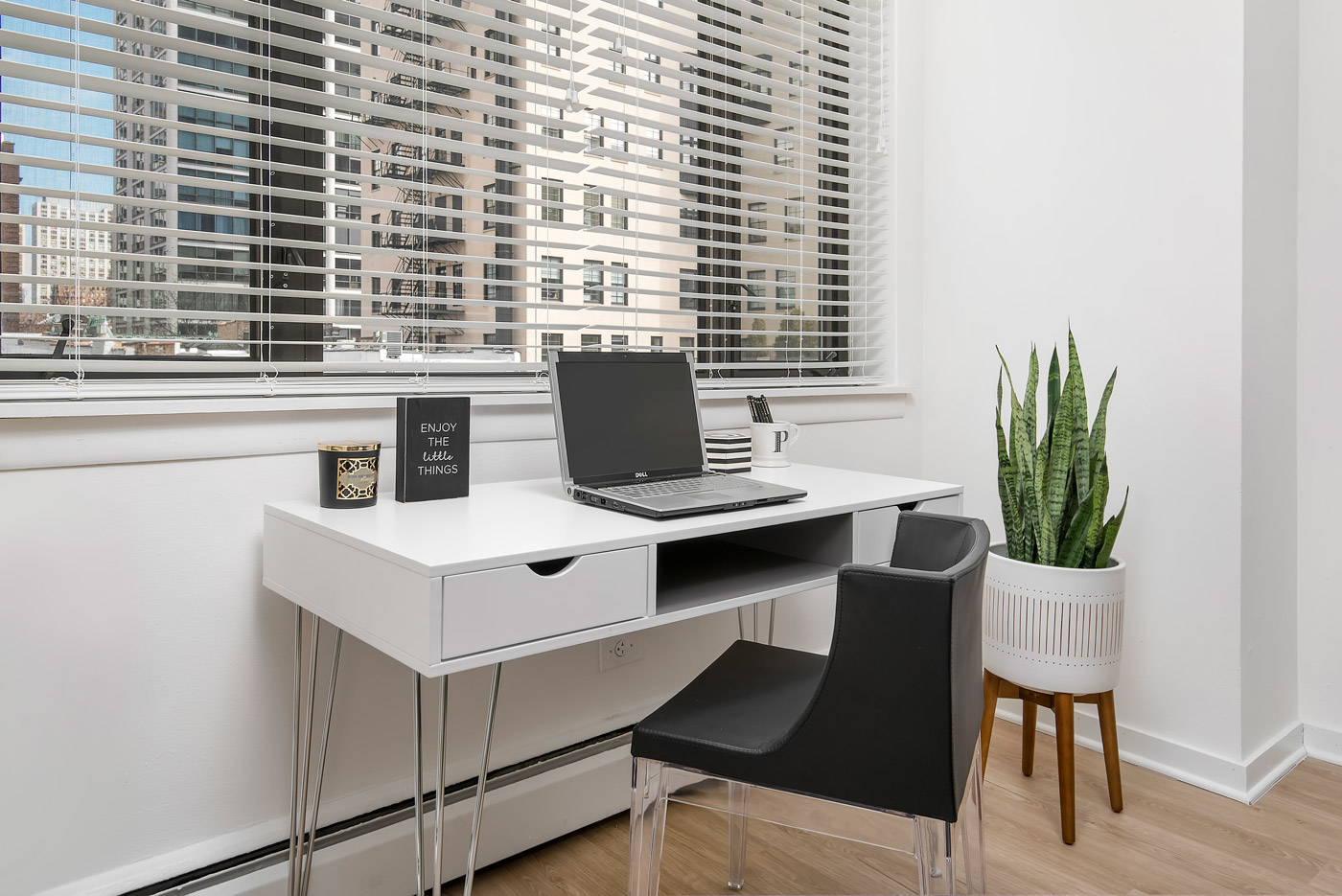
The challenge of working from a studio or one-bedroom apartment is not really about space. It is about separation. In a traditional office, the physical act of commuting creates a mental transition between home and work. When your apartment is your office, that transition has to be manufactured deliberately, and the way you design and arrange your space is the primary tool you have for doing it.
This guide covers how to create a functional, focused home office within the constraints of a studio or one-bedroom apartment without sacrificing the livability of the rest of the space.
Why Spatial Separation Matters More Than Square Footage
A Microsoft survey of remote workers found that the blurring of boundaries between work and personal life was the most commonly cited challenge of working from home — outranking distractions, isolation, and technology problems. The degree to which work and rest occupy separate physical zones, even within the same small apartment, consistently shows up in the research as the variable most tied to sustainable remote work.
A dedicated desk in the corner of a studio can function as an effective psychological work boundary when it is intentionally designed and consistently used. A laptop on the coffee table, by contrast, tends to blur the boundary between work and leisure in both directions. The goal is not to create a separate room but to create a zone with a distinct character that your brain learns to associate with focus.
Choosing the Right Location for Your Home Office Within the Apartment
Natural light should be the first consideration when choosing where to position your workspace. Natural light supports focus, reduces eye strain, and has measurable effects on mood and alertness over the course of a workday.
A desk positioned perpendicular to a window — not directly in front of it, which creates glare on screens, and not directly behind it, which puts your face in shadow on video calls — captures natural light effectively without the downsides. If your apartment has multiple windows, the one that receives morning light is typically the best location for a primary workspace.
Avoid positioning your workspace immediately adjacent to or facing your bed if at all possible. The visual proximity of sleep and work spaces reinforces the psychological overlap between them. Even a few feet of separation, achieved through furniture arrangement or a room divider, makes a meaningful difference.
Essential Furniture for a Small-Space Home Office
Desk selection is the single most important furniture decision for a small-space home office. The desk needs to be large enough to accommodate your actual workflow without overwhelming the apartment visually or consuming floor space needed for other functions. For studios where space is tight, secretary and bureau-style desks are worth considering — they close completely when not in use, effectively removing the workspace from the visual environment during non-work hours. For one-bedrooms and larger studios, a standard compact desk under 48 inches wide typically provides enough surface without crowding the room.
Ergonomics are non-negotiable for anyone working full days from home. An adjustable chair that supports your back, a monitor or laptop stand that positions the screen at eye level, and keyboard and mouse positioned to keep your wrists neutral prevent the cumulative strain that builds up invisibly over months of daily use.
Managing Visual and Acoustic Separation
Distinct lighting for the work zone versus the rest of the apartment helps signal the transition between modes. A dedicated task lamp at the desk, paired with ambient lighting in the living area, creates two visually distinct environments within the same space.
A bookshelf, open shelving unit, or room divider positioned between the desk and the living area creates a visual boundary without requiring a wall. Even a partial visual separation signals that the two spaces serve different purposes.
A small rug under the desk area, different from the flooring treatment in the rest of the space, contributes to the same effect through material distinction.
Acoustic management matters for video call quality and for focus. Heavy curtains reduce sound transmission from outside. A white noise machine or app running during work hours masks ambient apartment sounds and creates a consistent sonic environment associated with focus.
Technology and Connectivity Considerations for Apartment Home Offices
Reliable, fast internet is the non-negotiable infrastructure requirement for working from home, and it is worth verifying before you sign a lease rather than assuming it will be adequate. Confirm that the building has fiber optic internet available, and that the specific unit receives strong signal. A dedicated router rather than relying on shared building Wi-Fi is standard practice for anyone doing video conferencing or large file transfers.
Cable management is a quality-of-life detail that becomes obvious within a week of setting up a home office. Planning for power strip placement and cable routing before you arrange the space saves significantly more time than addressing it after the fact.
Maintaining Work-Life Balance When Your Apartment Is Your Office
The psychological challenge of working from home in a small apartment is not solved by furniture and lighting alone. Establishing consistent start and end times for the workday, and treating the act of sitting down at the desk and closing the laptop at the end of the day as deliberate transitions, helps maintain the separation that small-space home office design supports structurally.
Leaving the apartment during the day is one of the most practical tools for counteracting the isolation that full-time remote work can quietly produce. A 2025 Headway survey of 1,000 remote workers found that 56% go entire weeks without leaving their homes — a pattern strongly associated with decreased well-being and productivity. A lunch out, a coffee shop work session, or a midday walk all make a meaningful difference.
Buildings with shared amenities like fitness centers, resident lounges, or business centers add valuable variety to the daily environment for remote workers who want to change their setting without leaving the building.
Find a Remote-Work Ready Apartment With PPM
PPM’s apartments in River North, Gold Coast, Lincoln Park, and Lakeview are located in neighborhoods that support productive remote work: walkable to coffee shops and lunch spots, connected to transit for hybrid days in the office, and surrounded by neighborhood infrastructure that makes leaving the apartment easy and rewarding throughout the day. Several PPM properties include business centers, fitness centers, and resident lounges that extend your functional workspace beyond the apartment itself.
Browse available floor plans that are well-suited for remote working to compare layouts and building amenities across all four neighborhoods, and contact the leasing team to discuss which properties and unit types best suit your work-from-home setup.


